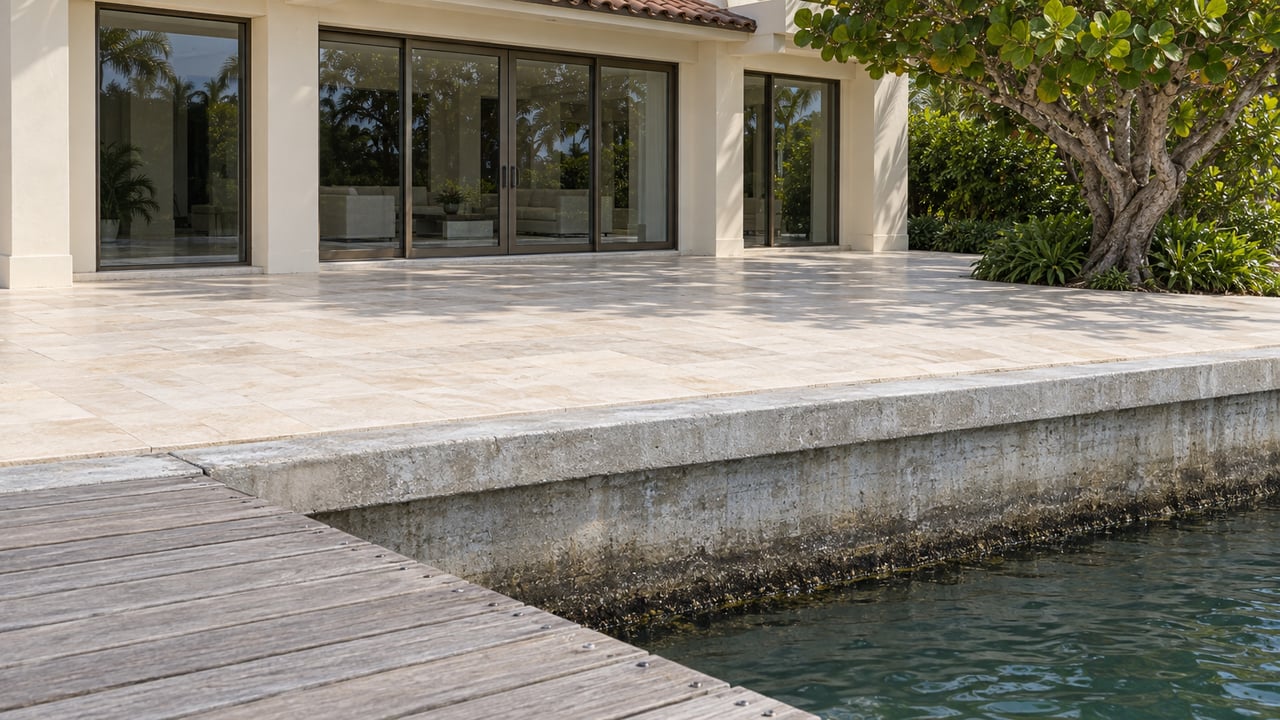
In Aqualane Shores, the Seawall Is Never the Insurance Company's Problem
October 1, 2026
October 1, 2026
Ask a buyer under contract in Aqualane Shores what their flood policy covers, and most will say the house, the dock, and the seawall, since all three sit on the same lot and all three touch the same water. Only one of those three is actually insured by that policy. The other two are excluded by design, and the gap between what people assume and what the paperwork says is where waterfront deals in this particular neighborhood get interesting.
That assumption is not unreasonable on its face. Most buyers moving into Aqualane Shores are coming from inland homes where flood insurance was a line item on a closing statement, not a document that governs how the property actually functions day to day. Aqualane Shores runs differently. The entire premise of the address, the reason a lot here costs what it costs, is that a boat can leave a private dock and reach Naples Bay and Gordon Pass in well under fifteen minutes, with canal depths commonly running eight to ten feet at mean low water. Take away the dock and the seawall behind it, and you have taken away the thing the address is actually selling.
A standard National Flood Insurance Program policy insures the structure of the home and, depending on the form selected, certain contents. It was built to protect a building against rising water, full stop. Seawalls, bulkheads, docks, and similar marine structures sit outside that scope from the start. This is not a Naples quirk or fine print someone buried on purpose. It is the same exclusion language nationwide, and Florida's own insurance regulators list it plainly: fences, piers, seawalls, bulkheads, wharves, and docks on or over water are not covered property under a standard flood policy.
What changes from one neighborhood to the next is how much work the excluded structure is actually doing. On a canal-front Aqualane Shores lot, the wall and the dock are doing more than almost anywhere else in the city. They are not decorative. They are the physical mechanism that delivers no-bridge Gulf access, and a flood policy has nothing to say about the mechanism itself. It only protects the house sitting behind it.
Homeowners insurance does not fill that gap either. Standard homeowners policies typically exclude flood-related damage entirely, which means marine structures fall outside both flood and standard homeowners coverage in most cases. Some private flood carriers write broader definitions that include marine structures, but that has to be confirmed in writing with a specific carrier rather than assumed from a quote summary.
Here is the detail that catches even careful buyers off guard. The City of Naples created the West Naples Bay Special Taxing District specifically to fund canal maintenance, including dredging and seawall inspection, for the canals inside Aqualane Shores. According to the city's own ordinance language, that district covers canal-front parcels running roughly between 14th Avenue South and Galleon Drive. It does not include properties that face Naples Bay directly.
That single distinction means two homes on the same street can carry two entirely different maintenance and assessment profiles. A canal-front parcel inside the district may be subject to a future dredging assessment tied to that district's funding structure. A bay-facing parcel a few doors down is not part of the district at all, which puts its maintenance obligations and cost exposure on a completely separate track. Nobody's homeowners insurance mentions this. It only shows up when someone calls the city and asks the right question about a specific parcel.
None of this is abstract risk sitting decades out. Aqualane Shores was platted starting in 1949, the same year Naples became a city, with the first homes completed the following year. A meaningful share of the neighborhood's seawall infrastructure has already lived through multiple decades of tidal flow and storm cycles. Concrete and well-built vinyl or composite seawalls generally hold up for 30 to 50 years with regular maintenance, which puts a good number of original-era walls somewhere near the end of that window even after renovations elsewhere on the lot.
The permitting side is comparatively modest. A dock or seawall permit in the City of Naples runs roughly $0.30 per square foot with a $100 minimum, plus a plan review fee equal to 20 percent of the permit cost. That is not where the real exposure sits. The exposure sits in the repair or replacement bill that follows once a wall actually starts failing, and a seawall does not fail from the top down in a way that shows from the yard. Most of the damage that eventually becomes a six-figure repair starts behind the wall, invisible until a tie-back lets it rotate forward.
For buyers and sellers working a canal-front deal in Aqualane Shores, the diligence list is short but specific:
The neighborhood association is not a resource for any of this. It coordinates community matters and shares updates from the city, but seawall and dock repair remains the individual owner's responsibility under standard Florida practice, confirmed by deed. The city's own finance department maintains the records on special assessment areas, and confirming taxing district status is a five-minute phone call that is far better made before closing than after.
None of this changes what makes Aqualane Shores worth what it costs. The deep water, the no-bridge access to the Gulf, and the short walk to Third Street South's restaurant row, including The Continental, Campiello, and Osteria Tulia, are still the draw and still hold up under scrutiny. It just means the diligence has to match the value sitting behind the wall, not the value printed on the flood declaration page.
Does my homeowners insurance cover the seawall if my flood policy doesn't? In most cases, no. Standard homeowners policies typically exclude flood-related damage entirely, and marine structures like seawalls and docks fall outside both flood and standard homeowners coverage. Some private flood carriers offer broader definitions that may include marine structures, which is worth confirming directly and in writing when comparing quotes.
How do I confirm whether a specific lot is canal-front or bay-facing for taxing district purposes? The City of Naples finance department, along with streets and stormwater, can confirm which special taxing district, if any, applies to a given parcel. This is worth doing before closing rather than after.
Does the Aqualane Shores Association handle seawall repair? No. The association coordinates neighborhood matters and passes along city updates, but seawall and dock repair remains the owner's responsibility under standard Florida practice.
A canal-front address in Aqualane Shores is still one of the more defensible waterfront positions in Naples, and the numbers above are meant to sharpen a purchase or a listing, not complicate it. If you are weighing a specific parcel here and want to walk through what applies to that lot before you write an offer or set a price, Teresa Krapf can help you get the taxing district and seawall questions answered directly.
Stay up to date on the latest real estate trends.


As real estate advisors with a background in investing and development, we provide a unique perspective, guiding our clients beyond transactions and focusing on long-term value, quality, and lifestyle.
Licensed Florida Real Estate Company
Teresa Krapf-Dobr
T: (239) 367-2896
[email protected]
Lukas Krapf-Dobr
L: (239) 888-9254
[email protected]
Address
1164 Goodlette Rd N
Naples FL 34102